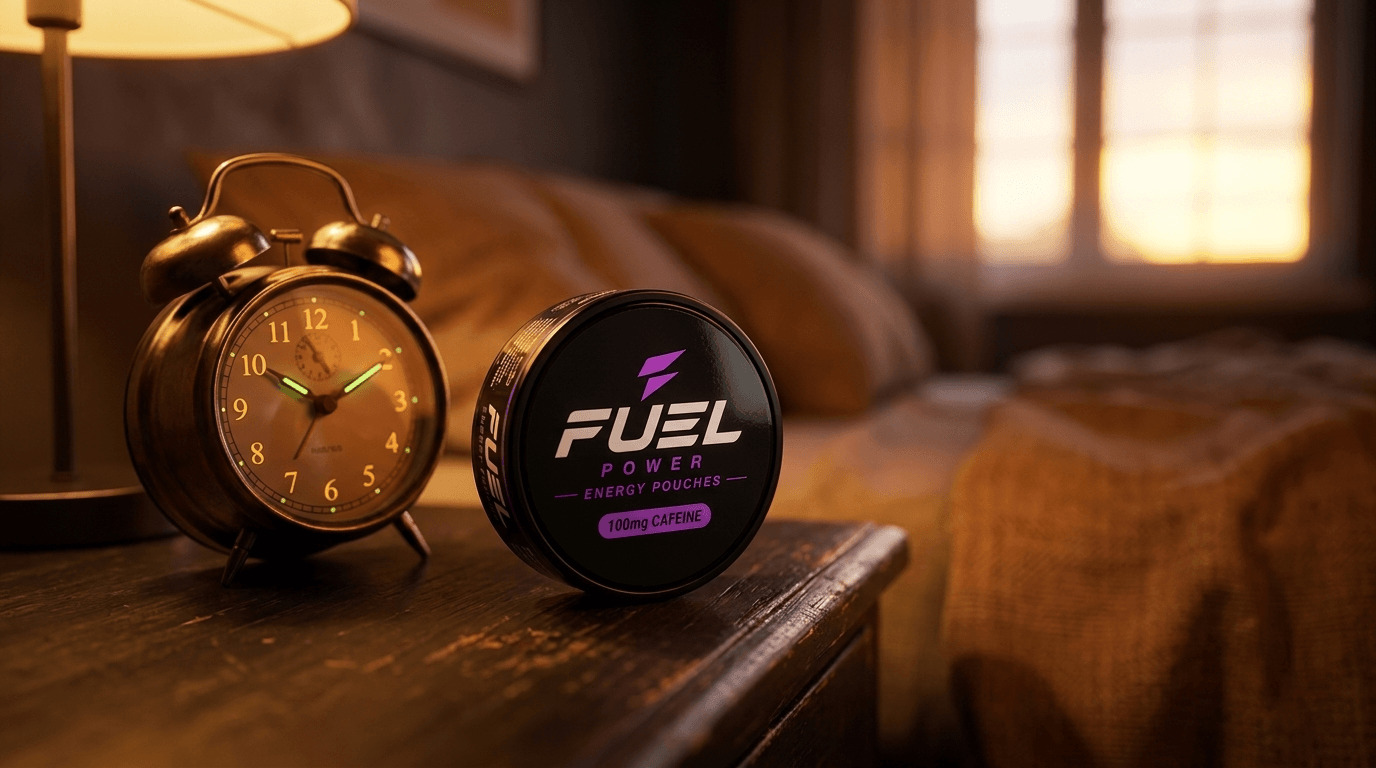
You don't feel the effect of your 4pm coffee anymore by the time you go to bed, so you assume your sleep is unaffected. Except not feeling the stimulating effect anymore doesn't mean caffeine has finished its work in your body. And that distinction changes quite a bit.
The mechanism, in one sentence
Caffeine blocks adenosine receptors, the molecule that builds up in the brain throughout the day and pushes you toward sleep. As long as caffeine occupies these receptors, the fatigue signal stays masked — even though, biologically, sleep pressure keeps building up in the background.

How long caffeine actually stays in the body
This is where it gets tricky: caffeine doesn't disappear all at once. Its half-life — the time needed to eliminate half of it — is generally between 3 and 7 hours depending on the person, a range that largely depends on genetic factors (more on this in our article on caffeine sensitivity). In practice, a pouch taken at 4pm can still have an active share in your body at 10pm, even if you don't feel anything in particular anymore.
What EFSA precisely says on this topic
The European Food Safety Authority has a fairly clear stance on this. On its page dedicated to caffeine, the agency states that a single 100mg dose of caffeine — exactly the dose in a FUEL POWER pouch — can affect sleep duration and quality in some adults, particularly when consumed close to bedtime. This isn't a vague, general warning: it's a precise benchmark, tied to the exact dose we're dealing with here.
So, what's the actual cutoff time?
There's no universal rule set in stone, but common sense points to a clear pattern: the closer you get to bedtime, the greater the risk of an impact on sleep, even if you no longer feel the stimulating effect. A reasonable safety margin, often mentioned by sleep specialists, is around 6 to 8 hours before bedtime. If you go to bed around 11pm, that ideally places your last caffeine intake around 3-5pm, a bit earlier if you're more sensitive or a slow metabolizer.
Cases where you should be extra careful
Some situations call for an even wider margin:
- If you recognize yourself in the "sensitive" profile described in our article on caffeine sensitivity, it's better to move your cutoff earlier in the afternoon.
- If you stack several caffeine sources throughout the day (see our article on what 100mg represents daily), the total dose still active at bedtime can be higher than you think.
- If you already have restless nights or light sleep, reducing your risk margin has more impact than for someone who sleeps deeply without difficulty.
Conclusion
The real problem with caffeine and sleep isn't the dose itself, it's the timing of when you consume it. A dose as modest as 100mg, taken too close to bedtime, can be enough to degrade the quality of a night that otherwise seemed complete. Shifting your last intake a few hours earlier in the afternoon is often the simplest and most effective adjustment.
FAQ
What time should I stop caffeine if I go to bed at 11pm? A margin of 6 to 8 hours before bedtime is often recommended, which would place your last intake around 3-5pm.
Why don't I feel the effect of caffeine anymore but still sleep badly? Because the disappearance of the stimulating sensation doesn't mean caffeine has been fully eliminated from your body.
Can 100mg of caffeine really disrupt sleep? Yes, according to EFSA, a single 100mg dose can affect sleep duration and quality in some adults, especially if taken close to bedtime.
Is caffeine's half-life the same for everyone? No, it generally varies between 3 and 7 hours depending on the person, based on genetic and individual factors.
Can a FUEL POWER pouch taken in the afternoon disrupt my night? It's possible depending on the exact timing and your personal sensitivity. It's best to consume it with enough of a margin before bedtime.
Want to use your FUEL POWER pouch at the right time of day? Discover the 6 available flavors.