There's always someone in your life who drinks a coffee at 10pm and falls asleep half an hour later like it's nothing. And then there's you, maybe, who still feels the effects of a tea taken at 4pm by the time you go to bed. It's neither luck nor a whim. It's largely a matter of genetics — and understanding yours changes quite a bit about how you manage caffeine day to day, FUEL POWER pouches included.
What "caffeine sensitivity" actually means
The term is a bit of a catch-all, so let's clarify. We're not talking about an allergy here — caffeine almost never causes one — but about a very real variation in how your body reacts to the same dose. Two people consuming 100mg of caffeine can have radically different experiences: one barely feels more awake, the other has a racing heart and slightly trembling hands. Both reactions are perfectly normal. They just reflect bodies that don't process caffeine the same way.
Signs that should get your attention
Certain signals come up more often in sensitive people. None is serious on its own, but their accumulation or intensity is worth paying attention to:
- Palpitations or a racing heart sensation, even after a modest dose.
- Jitteriness or restlessness that's hard to explain otherwise.
- Slight trembling, particularly in the hands.
- Digestive issues (cramps, urgency) that almost systematically follow caffeine intake.
- Trouble falling asleep even though your last dose was several hours earlier.
- Anxiety that seems to appear for no particular reason within the hour after consumption.
If you recognize several of these signs, and they come up fairly consistently, there's a good chance you're more sensitive than average to this molecule.
Genetics explains a large part of the story
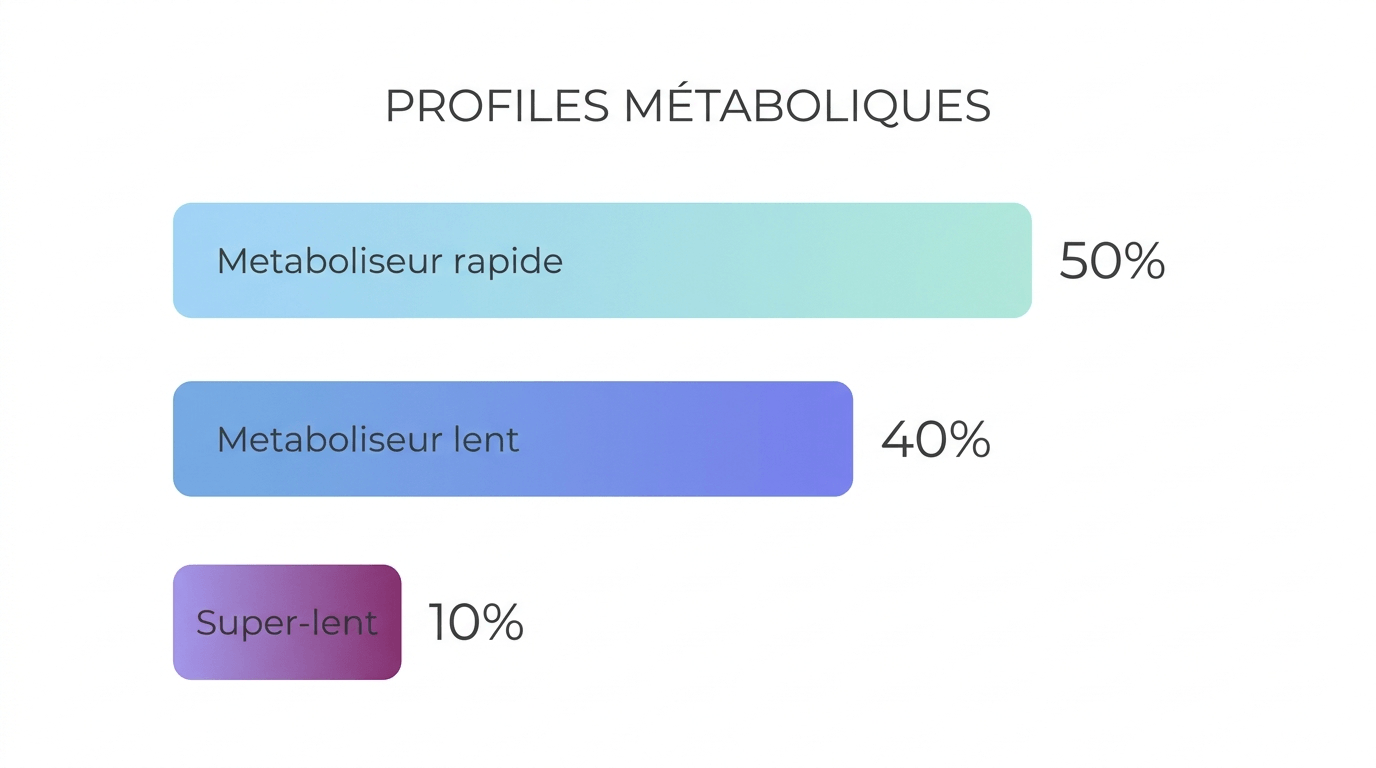
This is the most underrated point in this topic. Your ability to eliminate caffeine depends largely on a liver enzyme, CYP1A2, whose activity varies between people based on small genetic differences. Nutrition science researchers note that about half the population carries two copies of the "fast" version of the gene, making them fast metabolizers — they eliminate caffeine fairly quickly and feel fewer prolonged effects. About 40% have only one copy, and are considered slow metabolizers. The remaining 10% have neither: these are the "super-slow" metabolizers, in whom caffeine can take up to eight hours to be half-eliminated, compared to just two hours in the fastest metabolizers.
In other words, if you recognize yourself in the slow metabolizer description, it's not a matter of poorly developed tolerance or lack of habit: your liver is literally processing the molecule more slowly than that of your colleague who runs on coffee all day with no apparent issue.
A table to make sense of it
| Genetic profile | Share of the population | Elimination speed | What this means in practice |
|---|---|---|---|
| Fast metabolizer | About 50% | Fast (around 2h to eliminate half the dose) | Less prolonged effects, apparently higher tolerance |
| Slow metabolizer | About 40% | Moderate | More pronounced and longer effects, including on sleep |
| Super-slow metabolizer | About 10% | Slow (up to 8h) | Markedly increased sensitivity, even at modest doses |
Other factors add to genetics
Genetics provides a foundation, but it doesn't explain everything. Several other elements influence how you react to caffeine, and they're worth keeping in mind.
Age
With age, the body's ability to eliminate certain substances tends to slow down, which can increase sensitivity to caffeine in older people, even without any change in consumption.
Smoking
It's counterintuitive, but smoking speeds up CYP1A2 activity, which means smokers generally eliminate caffeine faster than non-smokers. This is obviously not an argument in favor of smoking — the associated risks far outweigh this small metabolic "advantage" — but it explains why some smokers feel like they can "handle" much more coffee than the people around them.
Pregnancy
Caffeine metabolism slows down noticeably during pregnancy, which is why health authorities recommend a lower consumption threshold in this situation.
Consumption habits
Regular consumption leads to a form of tolerance that can partly mask an underlying genetic sensitivity. Someone who's had coffee every day for years might feel like they "handle it well," while biologically their body remains a slow metabolizer.
Health authorities also note, in their general caffeine guidance, that these multiple factors of individual variability make it difficult to define a universal threshold that applies to everyone — which, in effect, confirms that there's no identical "safe" dose for everyone.
How to identify your own sensitivity in practice
No need for a genetic test to get a fairly accurate idea. Here's a simple method, over a few days:
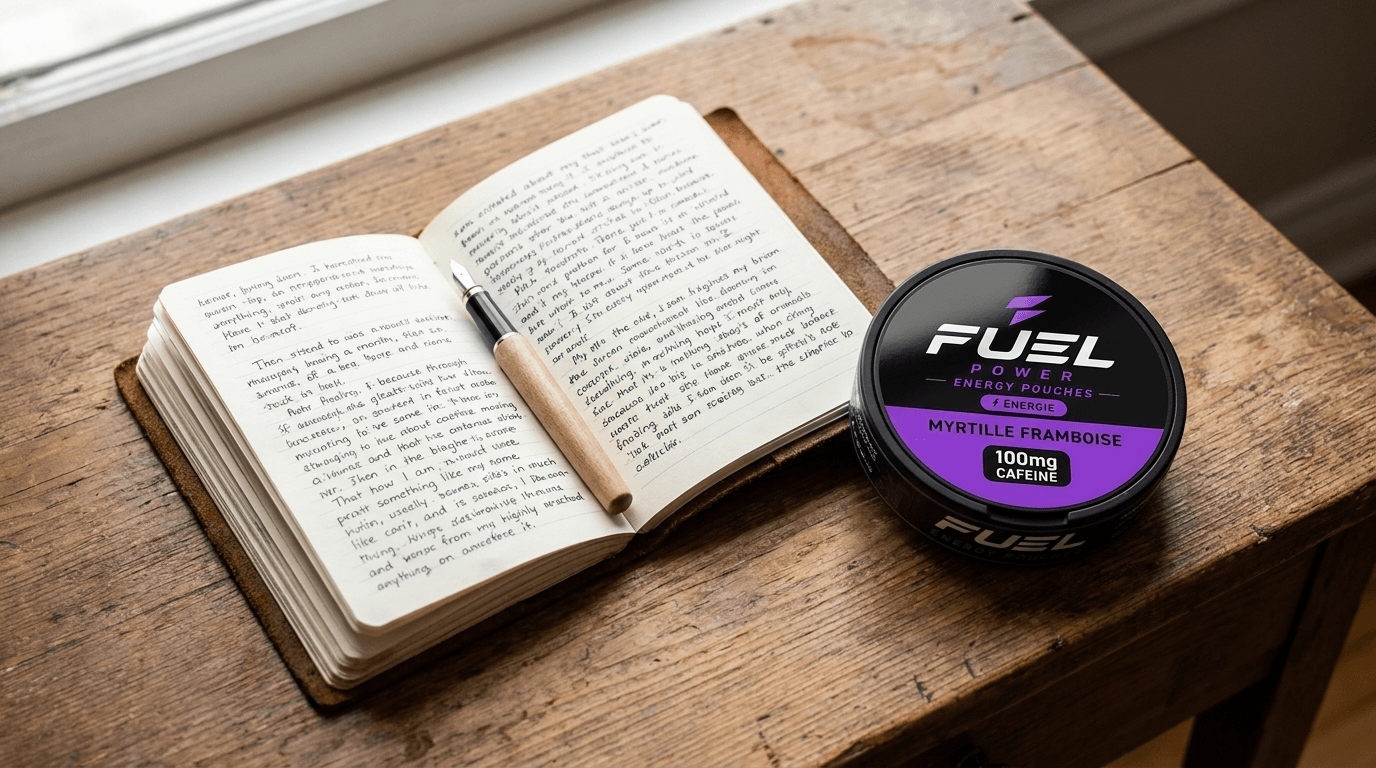
- Take a known reference dose — a 100mg FUEL POWER pouch, for example — always at the same time of day, mid-morning.
- Note what you feel over the following hour: alertness, jitteriness, palpitations, or nothing in particular.
- Observe your sleep the following night, especially if you took the dose later than usual.
- Repeat the exercise two or three times to see if the pattern holds.
If you consistently feel marked signs even at a modest dose, or if your sleep is disrupted even though you took it hours earlier, you probably have your answer: it's better to consume less, earlier in the day, or space out your intake more.
What this means for your FUEL POWER pouch consumption
If you recognize yourself as fairly sensitive, a few simple adjustments are usually enough:
- Stick to a single pouch rather than stacking them, and observe the effect before having another. Our article on how many pouches per day at most gives broader benchmarks if you want to fine-tune your own threshold.
- Avoid any intake in the late afternoon or evening, since increased sensitivity makes sleep disruption more likely.
- Don't confuse sensitivity with dependence: the two topics are related but different, as detailed in our article on dependence on nicotine-free energy pouches.
- Keep in mind that 100mg remains a notable dose: our article on what this dosage represents lets you compare it with what you're already consuming elsewhere.
Conclusion
Being sensitive to caffeine is nothing abnormal, and even less a problem to fix at all costs. It's largely a genetic trait as ordinary as eye color. The real difference lies in recognizing it in order to adjust your consumption accordingly, rather than forcing a tolerance that will never really come.
FAQ
Is caffeine sensitivity hereditary? Largely, yes. It depends notably on variants of the CYP1A2 gene, which influences how fast the liver eliminates caffeine.
Can you become less sensitive to caffeine over time? A certain tolerance can develop with regular consumption, but it doesn't change your underlying genetic metabolism profile.
Does smoking really make you less sensitive to caffeine? Smoking speeds up the activity of the enzyme that eliminates caffeine, which can give that impression, but it's absolutely not a reason to smoke.
How can I tell if I'm a slow metabolizer without a genetic test? By observing your reactions to a known, regular dose: repeated palpitations, jitteriness or sleep disruption are good indicators.
Is a 100mg FUEL POWER pouch too strong for a sensitive person? Not necessarily, but it's recommended to start cautiously, observe your reaction, and avoid taking it late in the day.
Does caffeine sensitivity increase with age? It's a trend observed in many people, linked to an overall slowdown in metabolism, but it's not systematic.
Should I see a doctor if I have marked caffeine sensitivity? This generally isn't necessary for ordinary sensitivity, but frequent or worrying palpitations are worth mentioning to a healthcare professional.
Want to test your own sensitivity with a precise, known dose? Discover the 6 FUEL POWER flavors, all dosed at 100mg of caffeine.